


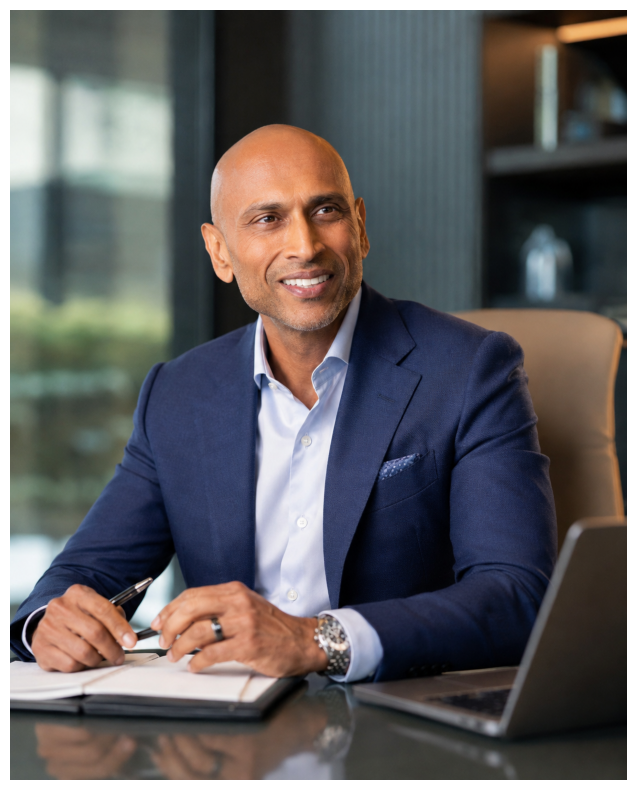
Today we’d like to introduce you to Manuj Agarwal.
Hi Manuj, can you start by introducing yourself? We’d love to learn more about how you got to where you are today?
My life has taken enough unexpected turns that I’ve stopped believing careers are supposed to follow straight lines.
Before medicine, I worked at the U.S. Patent and Trademark Office. I wasn’t an engineer, even though they primarily hired engineers. Somehow I talked my way into the job and then spent a lot of time teaching myself what I needed to know. This was before AI, so Wikipedia was basically my engineering professor.
It taught me early that I was comfortable entering spaces where I didn’t know everything yet. It also taught me something I still believe: having an idea is easy. Building something from it is much harder.
I eventually went to medical school. Then, during my first year in 2007, I was hit by a car.
I was young, active and just beginning this enormous journey toward becoming a physician. Suddenly I was on the other side of medicine. I had fractures, surgery, rehabilitation, complications and periods when normal life became much harder than I had ever imagined.
For a significant portion of medical school, I was simultaneously learning how to care for patients while learning what it felt like to be one.
That changed me.
Doctors see people during very concentrated moments of their lives. The patient experiences everything that happens between those moments—the waiting, the pain, the uncertainty, the loss of independence, the effect on the family.
That perspective never really left me.
The accident also changed the direction of my medical career. I had once imagined becoming a trauma surgeon. Ultimately, I found my way into radiation oncology and became especially interested in prostate cancer.
Then in 2013, cancer became personal in a different way when my mother was diagnosed.
Once again, I was living on both sides of medicine. This time I understood cancer professionally, but I was also a son asking the questions families ask: What else can we do? How do we keep her strong? What should she eat? Should she exercise? How do we help her tolerate treatment? What happens to the rest of her health while everyone is focused on the cancer?
That experience shaped how I think about oncology to this day.
Treating the cancer matters enormously. But the person with cancer is still a whole person.
That realization led me toward integrative oncology—not as an alternative to conventional medicine, but as a way of thinking more seriously about exercise, nutrition, sleep, rehabilitation, metabolic health, emotional health and function alongside excellent cancer treatment.
Years later, I was in another major car accident.
What fascinated me was that my recovery this time was dramatically different. I was much older, but I had also spent years exercising, strength training and building cardiovascular fitness. Five months after the accident I completed my first Murph workout. Six months later I ran a 10K. Within the year, I completed a 12-hour GoRuck event.
I recovered better in my forties than I had in my twenties.
That experience gave me a very tangible way to think about health: we are constantly building—or losing—reserve.
You don’t know when life will ask you to use it. It may be cancer. It may be an accident. It may simply be aging.
That idea now influences almost everything I do.
I still practice oncology, and cancer remains the lens through which I understand much of medicine. I also eventually founded Blue Wellth because I wanted a place to explore some of these broader questions about prevention, survivorship and what it actually means to remain capable as we get older.
But the thread running through all of it is probably simpler than any job title.
I’ve spent a large part of my life trying to understand what helps people remain themselves when health becomes uncertain.
And increasingly, I want to help make cancer and medicine feel a little less confusing to everyone else.
Would you say it’s been a smooth road, and if not what are some of the biggest challenges you’ve faced along the way?
Definitely not.
I’ve had periods when the path in front of me disappeared completely.
Getting hit by a car during medical school was probably my first real lesson in that. At that age, you assume your body will work when you ask it to. Suddenly mine didn’t.
There is something humbling about needing help with things you never previously thought about.
It also taught me patience, although I’m not sure I appreciated the lesson at the time. Recovery happens on a timetable that doesn’t particularly care about your plans.
My mother’s cancer diagnosis was different. There are some situations where expertise makes you feel more prepared, and others where it makes you more aware of everything that could happen. Being an oncologist did not make being a son easier.
Then there have been the professional transitions.
Medicine is incredibly structured. There is always another examination, another year of training, another credential. Eventually you reach a point where you can see a fairly predictable career ahead of you.
I stepped away from that predictability.
Building something outside the traditional academic path meant becoming a beginner again. I had to learn business, operations, technology, communication and dozens of things that had nothing to do with radiation oncology.
That was uncomfortable—and good for me.
One lesson I keep relearning is that resilience is usually much less dramatic than we make it sound.
It is rarely a movie moment.
It is doing the physical therapy when you don’t feel like it. Going for the walk. Making the phone call. Showing up again after something didn’t work. Taking the next small step when you cannot yet see the whole path.
My second accident reinforced that.
Afterward, I didn’t think, “I’m going to complete a 12-hour endurance event.” Initially, the goals were much smaller.
Stand up.
Walk.
Get stronger.
Return to exercise.
Then see what is possible.
That approach has carried into almost everything else I do.
I used to think resilience meant being tough enough not to be affected by difficult things.
Now I think it means being affected by them—and still continuing to grow.
Can you tell our readers more about what you do and what you think sets you apart from others?
I’m a radiation oncologist, and the deepest part of my clinical career has been in prostate cancer.
I’ve spent years helping men and their families make decisions that are often much more complicated than they first appear. In prostate cancer, there may be several reasonable options—surgery, radiation, brachytherapy, active surveillance, hormone therapy—and the “right” answer is not always simply the treatment with the best headline.
The real conversation is often: What matters most to this particular person? How aggressive is the cancer? What are the tradeoffs? What might treatment mean for urinary function, sexual health, energy, strength, cardiovascular and metabolic health, independence and quality of life?
I think that is what I have become known for most: taking complicated medicine and making it understandable without oversimplifying it.
I love the technical side of oncology. Radiation oncology combines physics, imaging, anatomy, biology and some remarkable technology. I have spent much of my career working with advanced radiation techniques and prostate brachytherapy.
But over time, I became just as interested in everything surrounding the treatment.
My mother’s cancer diagnosis changed that perspective significantly. I began asking questions not only about controlling cancer, but about what happens to the rest of a person’s health while we are treating it.
That led me deeper into integrative oncology—using evidence-based exercise, nutrition, rehabilitation, sleep, metabolic health and supportive care alongside conventional cancer treatment.
More recently, that same curiosity has expanded into prevention and longevity. I founded Blue Wellth partly to create a place where I could explore those questions more deeply, particularly how people can build health before a crisis and preserve it when illness occurs.
But I still think of myself first as a doctor.
What I’m most proud of is not a title, publication or particular technology. It is the moments when someone walks into a conversation frightened and overwhelmed and leaves understanding their situation well enough to make a decision that feels like their own.
Cancer has a way of making people feel as though control has suddenly been taken away from them. Good communication can give some of that agency back.
I’m also increasingly passionate about doing that outside the exam room.
There is an enormous amount of health information competing for people’s attention now—social media, podcasts, AI, new cancer technologies, supplements, longevity claims and studies that get reduced to dramatic headlines.
I want to help people understand the difference between what we know, what looks promising, what remains uncertain, and what is mostly marketing.
What probably sets my perspective apart is that I’ve experienced medicine from several sides: as a physician, as the son of someone with cancer, and as a patient myself after serious injuries.
Those experiences have made me believe that medicine is ultimately not just about extending life or eliminating disease.
It is about helping people preserve the ability to live the life that matters to them.
That is the thread connecting almost everything I do now—from cancer treatment to integrative oncology, prevention, education and the conversations I hope to have with a much broader public.
Do you have recommendations for books, apps, blogs, etc?
My reading tends to cluster around a few themes: meaning, resilience, leadership, parenting and what it means to live well when life does not go according to plan.
When Breath Becomes Air by Paul Kalanithi has stayed with me because it captures what happens when a physician suddenly experiences illness from the other side. Man’s Search for Meaning by Viktor Frankl and The Last Lecture by Randy Pausch resonate for a similar reason: both are really about how we choose to live when we cannot control the circumstances.
I also love books that explore leadership and performance from very different worlds. Eleven Rings by Phil Jackson combines basketball, psychology, ego and team dynamics. Shoe Dog by Phil Knight is one of my favorite entrepreneurship stories because it shows how uncertain and messy building something actually is. And Be Where Your Feet Are by Scott O’Neil is a reminder I come back to often: be fully present for the people and moments right in front of you.
My podcast mix is just as varied. I listen to Oprah’s Super Soul for conversations about meaning and purpose; Ryan Holiday’s The Daily Dad and Raising Good Humans because parenting is something I am constantly trying to get better at; and Rhonda Patrick’s FoundMyFitness when I want to go deep on physiology and emerging health science.
AI has also become a major part of how I learn. I use it to explore unfamiliar topics, challenge my assumptions, synthesize research, compare competing viewpoints and turn a vague idea into something more structured. I find it especially useful when I want to move across disciplines quickly.
The challenge now is not simply getting access to information. It is knowing what deserves your attention, what needs to be verified, and where human judgment still matters most.
That combination—books, long-form conversations, emerging science and new technology—is probably how I do my best learning.
Contact Info:
- Website: https://bluewellth.com
- Instagram: https://www.instagram.com/blue_wellth/
- Facebook: https://www.facebook.com/profile.php?id=61576930187365
- LinkedIn: https://www.linkedin.com/in/magarwalmd/