


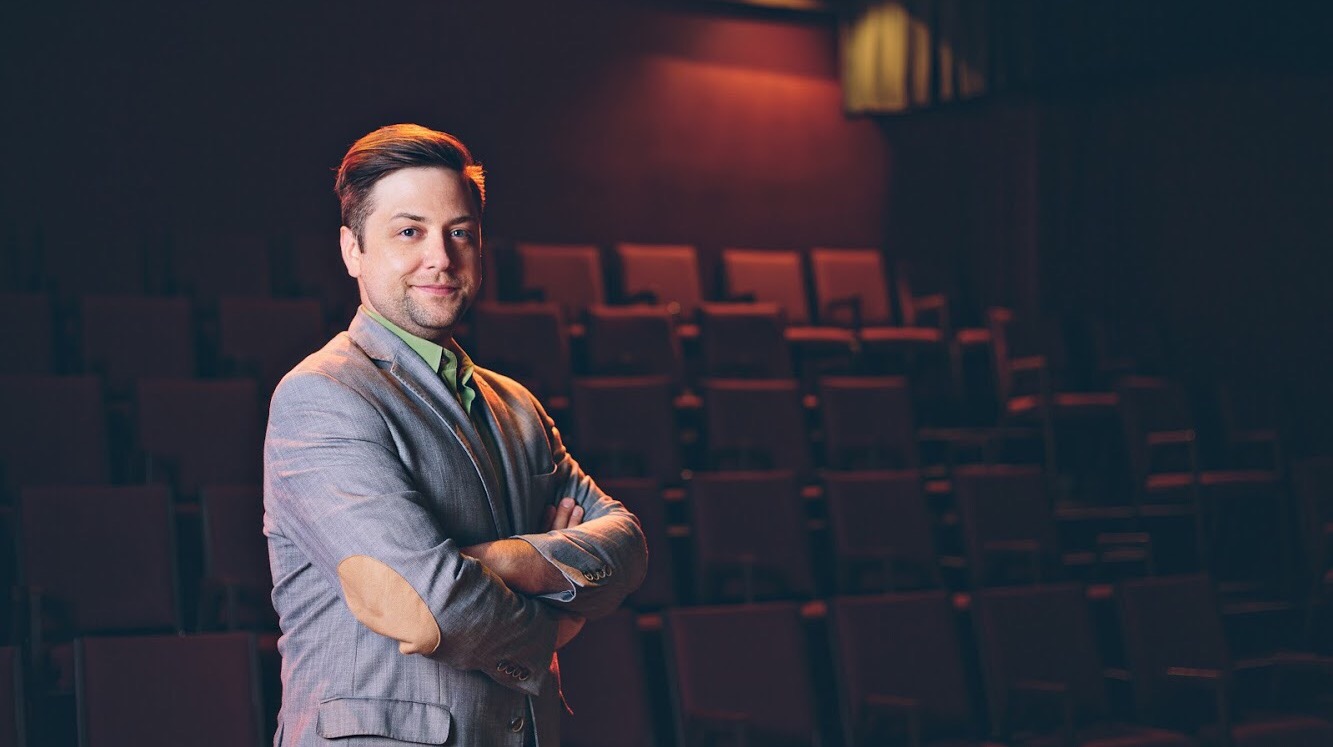
Today we’d like to introduce you to Stuart Landon.
Hi Stuart, we’d love for you to start by introducing yourself.
I was born in Bartlesville, Oklahoma, and grew up between Bartlesville and Houston, Texas. I suppose I was a theatrical producer before I knew that was a job. As a kid, I would gather my sister Rachel and the neighborhood children in our backyard and mount our own adaptations of whatever Disney movie had captured our imagination—sometimes something current, sometimes Bedknobs and Broomsticks. We made the shows, cast them, rehearsed them and performed them. Apparently, I started producing early.
I also spent an enormous amount of time wandering through the woods behind our house in Oklahoma. In my memory, those woods were absolutely gigantic. It was a pretty idyllic childhood—lots of imagination, lots of making things up, lots of music and storytelling.
My parents were enormously supportive of all of it. My dad was a chemical engineer and my mom had her own crafting business, but creativity was always part of our household. My dad taught himself instruments and loved music, and once Rachel and I became involved in theatre, my parents became involved too. They volunteered, served on boards and helped with our theatre booster programs. They were also involved in starting Sunfest, an arts festival in Bartlesville that is still going today.
Some of my earliest memories of that festival are of sitting completely transfixed by storytellers—many of them Native American storytellers—who could stand in a field with essentially nothing and hold an audience with just a story. There was also a Punch and Judy puppet show I adored. Add a steady diet of Jim Henson and some wonderfully strange and dark 1980s children’s movies, and you probably have a pretty good explanation for the artist I eventually became.
We moved to Houston when I was 10, and I was incredibly fortunate to grow up somewhere with strong theatre and arts education. I had wonderful theatre teachers who were actually allowed to teach theatre, and I found opportunities in school, community theatre, speech and forensics. Those teachers became mentors, and I don’t think I fully appreciated until I was older what a gift that was.
After high school, I returned to Oklahoma to study musical theatre at the University of Oklahoma’s Weitzenhoffer School of Musical Theatre, where I earned my BFA. After graduation, I moved to New York and spent the next few years doing what young actors do: auditioning, working wherever the next job took me, and figuring out how to build a life in the theatre.
Oddly enough, Pennsylvania had already entered my story. One of my first professional jobs, when I was 20, was at Millbrook Playhouse outside Lock Haven. I spent a wonderfully hot summer doing summer stock there, loved it so much that I came back a few years later, and made friendships that have lasted ever since.
Then, in 2006, an acting job at Allenberry Playhouse brought me back to Central Pennsylvania. I returned to Allenberry in 2007 and moved to Midtown Harrisburg that year. I thought I was coming here because I was an actor who got a job. I had no idea I was finding home.
That fall, I auditioned for Open Stage’s annual production of A Christmas Carol and was cast as Fred opposite the company’s longtime Scrooge, Nicholas Hughes. That led to another show, and another. A few years later, Open Stage founders Donald and Anne Alsedek offered me a part-time job as the theatre’s marketing manager and daytime box office person. That was 2010. I’ve been on staff ever since, taking on different roles over the years until becoming Producing Artistic Director in 2017.
Harrisburg became as important to my story as the theatre did. I fell in love with Midtown, but I think the real transformation happened when I stopped simply living in Harrisburg and started participating in it—volunteering, serving on boards and getting to know the people who were doing the work of building a community. Once I embraced Harrisburg, Harrisburg embraced me back.
In 2013, I also became part of the team at Midtown Cinema, our wonderful independent art house. My role there has changed over the years, but I still help program films—and once a month I get to sit with a group of improvisers for Down in Front! and make fun of spectacularly bad B-movies in front of an audience. It’s a very serious artistic responsibility.
At Open Stage, I’ve now had the extraordinary privilege of helping lead the company for nine seasons. We’ve expanded our programming and education work, rebuilt our downtown home to include three intimate performance spaces, and worked to make what we do more accessible through initiatives like ASL-interpreted performances and RADtix.
But underneath all of that, I think I’m still chasing the same thing that captivated me as a little kid listening to storytellers at Sunfest.
There is something extraordinary about sitting in a dark room with a group of strangers and being taken somewhere you’ve never been before. It can happen in a theatre like Open Stage or in a movie theatre like Midtown Cinema. For an hour or two, all of these people who may have almost nothing else in common agree to experience something together.
A story can make you ask a question you’ve never thought to ask. It can make you laugh until you hurt. It can break your heart. It can give you beauty, wonder, catharsis, thrills—or just two hours of glorious silliness when that’s exactly what you need. And it doesn’t always have to give you the answer. Sometimes asking the question together is enough.
I think together is the important word.
One of the loveliest parts of my own story is that it has become a family affair again. Rachel eventually moved to Harrisburg and became an important artist and educator at Open Stage. My brother-in-law Chris has acted, directed and designed here. My father has designed sound, played music and helped us in countless ways. In some ways, we’ve come full circle from that house filled with music and backyard plays in Oklahoma. We’re just making the shows on a slightly larger scale now.
And somewhere along the way, Pennsylvania became home. My partner Dan and I have been together for ten years, and we recently bought a house in the Colonial Park area with our two little dogs, two cats and considerably more garden than I have any idea how to manage. I’m discovering that my thumb may not be entirely black.
It’s amazing how quickly a life accumulates. I came to Central Pennsylvania because I was an actor who got a job. Twenty years later, I’m still an actor and still telling stories. I’m also a director, producer, arts administrator, film programmer, occasional B-movie heckler, increasingly questionable gardener, and the artistic leader of a theatre company that has become one of the great loves of my life.
Maybe the way I tell stories has changed since I was six or seven years old. But I don’t think the reason I tell them has.
It’s about connection.
Alright, so let’s dig a little deeper into the story – has it been an easy path overall and if not, what were the challenges you’ve had to overcome?
No, it absolutely has not been a smooth road. This is a hard business.
Money can be tight. You don’t always have healthcare. Rejection is commonplace, particularly when you’re an actor, and no matter how much you’re told not to take it personally, being told “no” over and over again can beat you down. I’ve been extraordinarily lucky to build the career and life that I have, and I’ve worked very hard to get here, but there have certainly been times when I’ve wondered how—or whether—it was all going to work.
One of the biggest challenges of my career actually came immediately on the heels of one of our greatest successes at Open Stage.
Our community helped us raise around $1 million through a capital campaign to completely reimagine our downtown theatre. We expanded into multiple performance spaces, created a new lobby, rebuilt backstage areas and transformed a home we’d occupied for decades. It was an enormous undertaking and, when we finally celebrated our grand reopening in October 2019, it felt like the beginning of an entirely new chapter for the company.
Five months later, the world shut down.
I’ve sometimes called the pandemic “the Great Intermission.” Suddenly, the thing our entire art form is predicated upon—people gathering together in a room—was the one thing we weren’t allowed to do.
At the time, I was directing Angels in America. We were undertaking both parts of Tony Kushner’s epic in repertory, with an extraordinary company of artists. We had essentially staged the first part and were moving into the second, preparing for a run that would take us through much of the spring and summer of 2020.
And then everything stopped.
For a while, like everybody else, we had no idea whether this was going to last a few weeks or much longer. So we kept rehearsing online. Eventually it became obvious that we weren’t going back into the theatre anytime soon, and we decided that if we couldn’t tell the story the way we’d intended, we were going to find another way.
We ultimately presented Angels in America virtually, divided into six parts. There was something unexpectedly profound about experiencing that particular work at that particular moment. Here was this monumental play about love, loss, isolation, community and another pandemic, being performed by people isolated in their homes for an audience isolated in theirs.
It wasn’t the production I had imagined. It couldn’t be. But it became something I will never forget.
That experience also helped set the course for what Open Stage did during the Great Intermission. Over the next 14 months, our staff and artists threw ourselves into figuring out how to keep creating. We made streaming programs, teleplays and strange hybrids of theatre, television and film that none of us had really been trained to make. We learned technology on the fly. We experimented. We failed at things. We tried something else. And we worked harder than I think any of us expected to work during a period when our theatre was technically “closed.”
I’m enormously proud of that time, but I also think it was probably the hardest period of my career.
There have been other difficult moments, of course. I’ve made mistakes. I’ve mishandled situations. There are productions, relationships, decisions and interactions I can look back on and know I would approach differently today. Leadership has taught me that you don’t get to become better by pretending you got everything right the first time. You try to recognize where you failed, learn from it, and hopefully don’t make the same mistake twice.
But I’ve also learned that challenges don’t always arrive looking like disasters. Sometimes they arrive disguised as enormous opportunities. Building a new theatre was incredibly difficult. Then, almost immediately afterward, an actual disaster arrived and made us rethink what theatre even was.
And strangely, both experiences taught me something similar.
The building matters. The stage matters. The seats and lights and scenery matter. But they’re not the theatre.
The people are the theatre.
When we couldn’t gather in the same room, we still found ways to make things together. We found ways to employ artists, tell stories, experiment, laugh, make mistakes and stay connected.
And eventually, when the Great Intermission ended, we got to turn the lights back on and invite everyone back into the room.
That meant more to me than I think I understood it could before they were gone.
Appreciate you sharing that. What else should we know about what you do?
I wear a lot of hats, which is probably true of most people who make a life in the arts.
I’m the Producing Artistic Director of Open Stage, a professional theatre in downtown Harrisburg that is now in its 41st season. I’m also an actor and director, and those identities are still enormously important to me. I don’t think of myself as an administrator who used to be an artist. I’m an artist who also happens to run an arts organization.
As Producing Artistic Director, I help shape the artistic vision of the company—choosing work, directing productions, developing programming, working with designers and actors, building partnerships, raising money and figuring out how to keep a professional theatre healthy and moving forward. And because this is a small nonprofit arts organization, on any given day that can also mean solving a plumbing problem, designing an ad, talking with a donor, moving a piece of scenery or figuring out why something that worked perfectly yesterday has suddenly stopped working today.
That’s part of what I love about it.
I’m particularly proud of how Open Stage has grown while remaining an intimate theatre. Our home in downtown Harrisburg has three performance spaces, and we now produce programming on roughly 150 days each year. We make plays and musicals, comedy, cabaret and new work; we have an education program through The Alsedek Theatre School; and our artists take theatre out into the community through programming that travels to schools, libraries, retirement communities and other spaces throughout the region.
Accessibility has also become an increasingly important part of our work. We’ve expanded ASL-interpreted performances and created RADtix, which makes free tickets available for our productions. I firmly believe that professional theatre should not be something you only get to experience if you have enough disposable income.
I’m also very proud of the range of work we make. Open Stage has always believed that theatre can ask difficult questions without supplying easy answers. At the same time, I’ve learned—particularly in the years since the pandemic—that there is enormous value in joy. A ridiculous comedy isn’t somehow less worthy than a devastating drama. Laughter can be cathartic. Escape can be necessary. Sometimes a spoonful of sugar helps the medicine go down, and sometimes the sugar itself is exactly what somebody needs.
I think that’s reflected in the work we’re doing right now. We’ve just opened Harold and Maude, a beautiful, funny and surprisingly profound story about choosing to live fully. Next comes Night of the Living Dead Live, an absolutely ridiculous parody and loving homage to George Romero’s classic film. At Christmastime, we’ll return to Emmet Otter’s Jug-Band Christmas, based on the Jim Henson television special I loved as a kid, alongside Who’s Holiday!, an decidedly adult comedy about what became of Cindy Lou Who. My sister Rachel will play Cindy Lou for the eighth and final year this December, which makes that one particularly meaningful to me.
My other artistic home is Midtown Cinema, Harrisburg’s independent art house, where I help with film programming. Theatre and film are very different forms, but I’m drawn to them for exactly the same reason: that communal experience. I love sitting in a packed movie theatre when everybody gasps at once just as much as I love standing in the back of an Open Stage audience when a moment in a play makes the whole room go completely still.
As for what sets me apart, I’m not sure that’s really for me to decide. There are extraordinary theatre artists and arts leaders throughout Central Pennsylvania doing incredible work, and I feel lucky to be among them.
What I can tell you is what I care about.
I care about heart.
I care about artists having a place where they can do brave work. I care about young people finding mentors who take their creativity seriously. I care about someone being able to walk into a theatre even if they can’t afford the ticket. I care about making work that is excellent without making art feel exclusive. And I care deeply about the idea that cities need artists—not as decoration, but as part of what makes a place worth living in.
Harrisburg has been Open Stage’s home for 41 years, and I believe enormously in this city and in the arts community throughout Central Pennsylvania. There are theatres, musicians, filmmakers, dancers, galleries, independent cinemas and individual artists making extraordinary things all around us. Go see them. Buy the painting. See the weird little play. Watch the independent movie you’ve never heard of. Take a chance on somebody’s new work.
Because every time we do that, we’re doing more than buying a ticket.
We’re choosing to gather.
And after spending my life in theatres, I think gathering together may be one of the most important things we do.
Where do you see things going in the next 5-10 years?
I firmly believe that gathering is going to win.
Maybe I believe that because this is what I do and, in order to remain sane, I have to believe I’m still relevant. But I actually think I’m right about this.
We live in this strange hyper-connected world where we can be on our phones 24 hours a day and still feel profoundly alone. We have an endless news cycle feeding us war, famine, hate, unrest and anxiety. We have algorithms sorting us into increasingly isolated silos. We have Netflix and streaming and the convenience of being able to decide that we want to watch some particular movie from 25 years ago and have it playing on our television 30 seconds later. We have what people now affectionately—or maybe not so affectionately—call “couch rot.”
And we have a genuine epidemic of loneliness.
So when people ask what theatre or cinemas need to do to compete with Netflix, I think we’re asking the wrong question.
We shouldn’t try to become Netflix. Netflix can’t become us.
A streaming service can give you almost anything you want whenever you want it, and that’s wonderful. I use them too. But it can’t recreate what happens when 100 people sit in a dark room together and something happens in front of them—or on a screen—and everybody gasps at the same moment. Or laughs together. Or cries. Or sits in complete silence because nobody quite knows what to say yet.
I think people are hungry for that. In fact, I think we’re already beginning to see it.
Human beings have been gathering to tell stories for essentially as long as we’ve been human. Before there were theatres, there were people sitting around fires telling one another what happened during the hunt. The Greeks gathered for theatre thousands of years ago. The technology changes, the stories change, the buildings change, but that fundamental desire to gather and experience something together hasn’t gone anywhere.
So, yes, I believe art is part of the solution to our loneliness.
That doesn’t mean our industry can simply sit back and wait for everybody to rediscover us. We have work to do. We have to listen to our audiences. We have to diversify what we offer. We have to make our spaces welcoming. We have to rethink traditions that no longer serve people. We have to make sure that participating in the arts is affordable, achievable and accessible. And we have to provide people with something worth leaving the couch for: enlightenment, education, entertainment, excitement, beauty, laughter, wonder and experiences they can’t get anywhere else.
The next five or ten years may be difficult for some arts organizations. The economics are hard, people’s habits have changed, and convenience is a powerful competitor.
But I’m incredibly optimistic.
Because I don’t think technology has eliminated our need for one another. If anything, it may be reminding us how much we’ve missed each other.
The experience we’re all searching for has been here all along. We just have to gather.
Contact Info:
- Website: openstagehbg.com & midtowncinema.com
- Instagram: openstagehbg & midtowncinema
- Facebook: https://www.facebook.com/openstagehbg/. & https://www.facebook.com/reilymidtowncinema/