


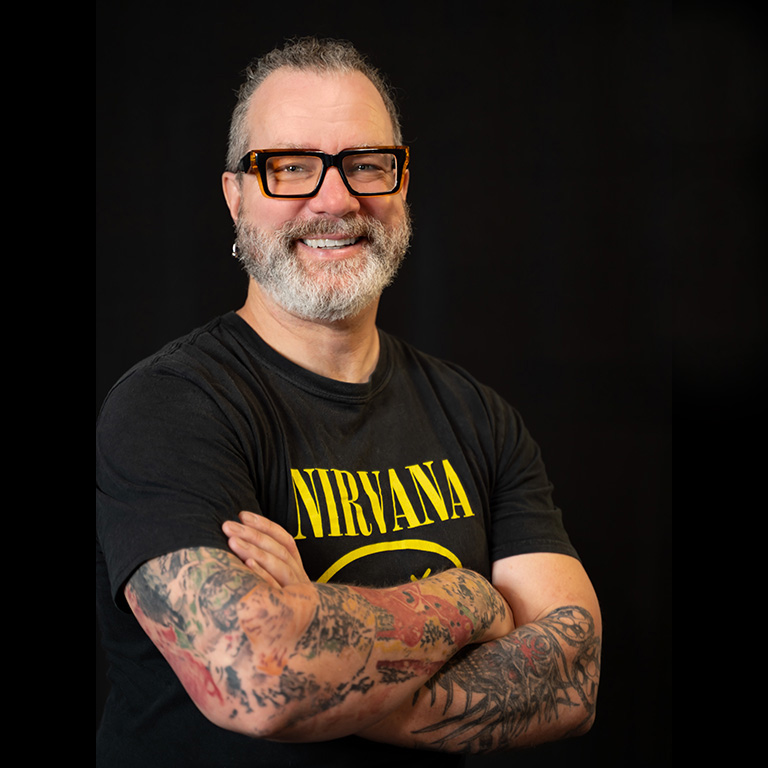
Today we’d like to introduce you to Scott Kowalski.
Hi Scott, we’d love for you to start by introducing yourself.
I have never followed a single, straight path as an artist. My creative life has moved through drawing, watercolor, photography, graphic design, publishing, web development, painting, murals, fabrication, and community organizing. Each chapter taught me another way to approach a creative problem.
I grew up in Altoona, Pennsylvania, and started taking formal drawing classes when I was around 11 or 12. Throughout high school, in addition to my regular art classes, I took private watercolor lessons with artist Joan Stern. She introduced me to color theory and to the discipline of watercolor, where you generally have to build a painting from light to dark. Just as importantly, she introduced me to a wider creative world. Altoona did not offer the same range of expression I associated with larger cities, and those lessons gave me a place to be around artists and young people who approached life differently. We also made loose-leaf tea every week. That warmth and sense of ritual stayed with me along with the painting techniques.
From 1990 to 1993, I attended the Art Institute of Pittsburgh, earning a degree in Visual Communications with a minor in Photography. Seattle had been calling to me since I was 14, when I read *Wizard of the Pigeons*. The book painted a magical picture of the city. By the time the grunge era arrived—with bands like Nirvana and Pearl Jam—my curiosity was impossible to ignore. I got on a bus with a bag and a couple of bucks and rolled into town. It was quite an adventure and a remarkable time to be there.
In Seattle, I began my professional career doing freelance graphic design and working at a print shop. I later worked for a metaphysical magazine called *The Third House*, where the director eventually invited me to Stockholm to become a Web Developer for Moonfire Records, a startup record label. I moved there in 1998, lived in Stockholm for about nine months, and later continued working for the company remotely—something still unusual at the time. When my visa expired, I had to leave Sweden and return to Pennsylvania.
I initially returned to Pittsburgh, but finding work was difficult, so I moved back to Altoona and established my own web-development and graphic-design business. I spent most of that period working independently, aside from three years with a marketing company. I returned to Pittsburgh in 2012 and have worked for myself ever since.
That same year, I discovered Art All Night. I submitted a painting, and it sold. It was not necessarily the first artwork I had ever sold—I honestly cannot remember when that was—but it was the moment that made me think, “Oh, I can actually do this.” Art All Night helped catapult me into seeing myself as an artist. It has also given me a lasting sense of creative community. I call it “the feeder of souls,” and I hope to remain involved with it for as long as I live in Pittsburgh.
Since then, I have continued mixing web and design work with painting, murals, and whatever interesting creative projects come my way. I once helped fabricate a diamond-plate booth for SEMA. That experience reflects something fundamental about me: as a creative, I have very little fear. Give me a project, and I will find a way to tackle it.
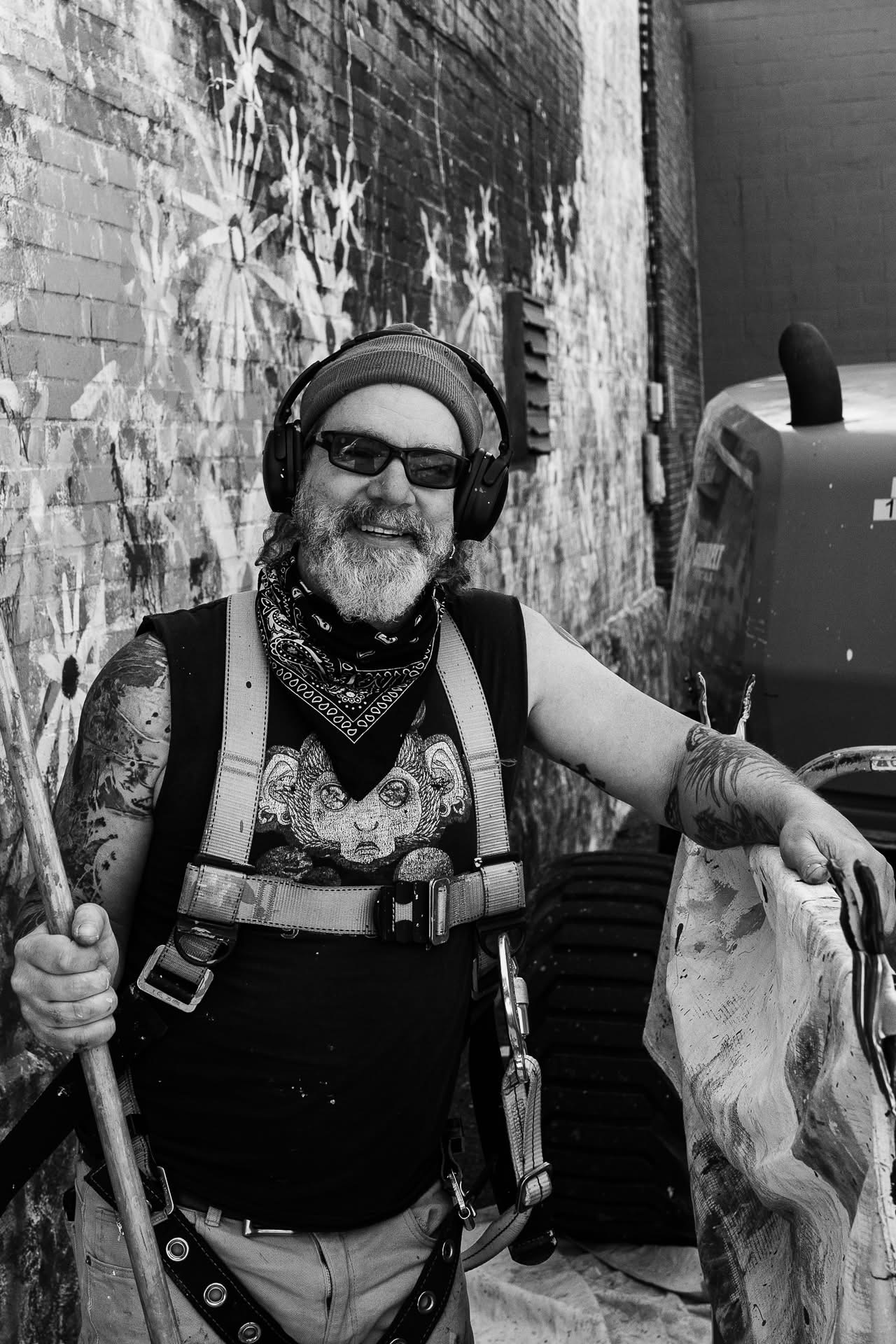
Over roughly the past decade, I have sold more than 700 pieces of artwork, primarily original abstract and expressionist acrylic paintings on canvas. I have also completed five murals around Pittsburgh. My most ambitious so far is the 30-by-90-foot mural I created for Humane Action Pennsylvania in 2026. It challenged me in entirely new ways and showed me that I can handle work—and not only murals—on a truly large scale.
Today, I describe myself as a multidisciplinary artist. My goal is not simply to make as much money as possible. What excites me are the big projects: ambitious, large-scale work that becomes part of a public space and reaches people I may never meet. That is where I want the next chapter of this journey to lead.
Can you talk to us a bit about the challenges and lessons you’ve learned along the way. Looking back would you say it’s been easy or smooth in retrospect?
No, it has definitely not been a smooth road. Some of the struggle came from being self-employed—finding work, dealing with inconsistent income, and constantly pursuing the next project. But a deeper struggle has been figuring out how someone like me is supposed to exist in a world that often expects a conventional path.
I have always been a hands-on learner and, from a very young age, something of a free spirit. I tend to question formulas and prescribed ideas about how things are supposed to be done. The usual plan—get the right job, follow the established steps, and fit yourself into a defined role—never felt natural to me. Although my life shows that I chose the road less traveled, I still spent years feeling as though I was supposed to fit into a shape that was never made for me. I am sure that resistance made certain things harder, but it is also part of what eventually allowed me to become a multidisciplinary artist.
Even when I was working in the more commercial worlds of graphic design and web development, I did not always fit the traditional corporate image of a business owner. I had long hair and a beard, and that did not sit comfortably with some rigid corporate expectations. People sometimes formed an initial judgment based on how I looked, so the quality of my work had to speak for itself and overcome those assumptions.
There is also a difficult tension between being an artist and earning a living. People may love what artists create without fully appreciating what it costs to produce original work. Many artists begin because they want to spend their lives making things, then discover that they must also become business owners, marketers, salespeople, and their own brand managers. Even accomplished artists have to keep promoting themselves to find the next commission.
I had some preparation for that reality through my career in graphic design and web development. When I returned to Altoona after my twenties, it felt as though life was saying, “You have explored; now you need to learn how to run a business.” I established a successful web-design business and supported myself through that work for nearly ten years. Altoona’s arts scene felt limited to me, but that chapter taught me what I was capable of professionally. When I returned to Pittsburgh, I brought those lessons with me and began exploring what else might be possible.
Moving itself created another challenge. Before social media made maintaining relationships easier, each relocation meant leaving much of your network behind and establishing yourself again in a new city. Every move required rebuilding connections, reputation, and opportunity.
Then there is rejection, which is immense in an artist’s life. You may apply for a grant or mural alongside 30—or 350—other artists and not be selected. You hear “no” far more often than “yes.” That can be difficult when the thing being judged feels so personal. The challenge is to remain resilient: to wake up the next day, keep painting, submit the next proposal, and try again.
Interestingly, murals themselves have not felt like a struggle. They are physical, mental, and emotional, but they came naturally to me and feel fun. The real challenge is creating the circumstances that allow you to keep doing the work you love.
I do not say any of this as a complaint. It has taught me determination and helped me understand why I continue. Art feeds my soul, makes me happy, and gives my life meaning. The road has been uncertain and unconventional, but I would not trade away the qualities that led me down it.
Thanks – so what else should our readers know about your work and what you’re currently focused on?
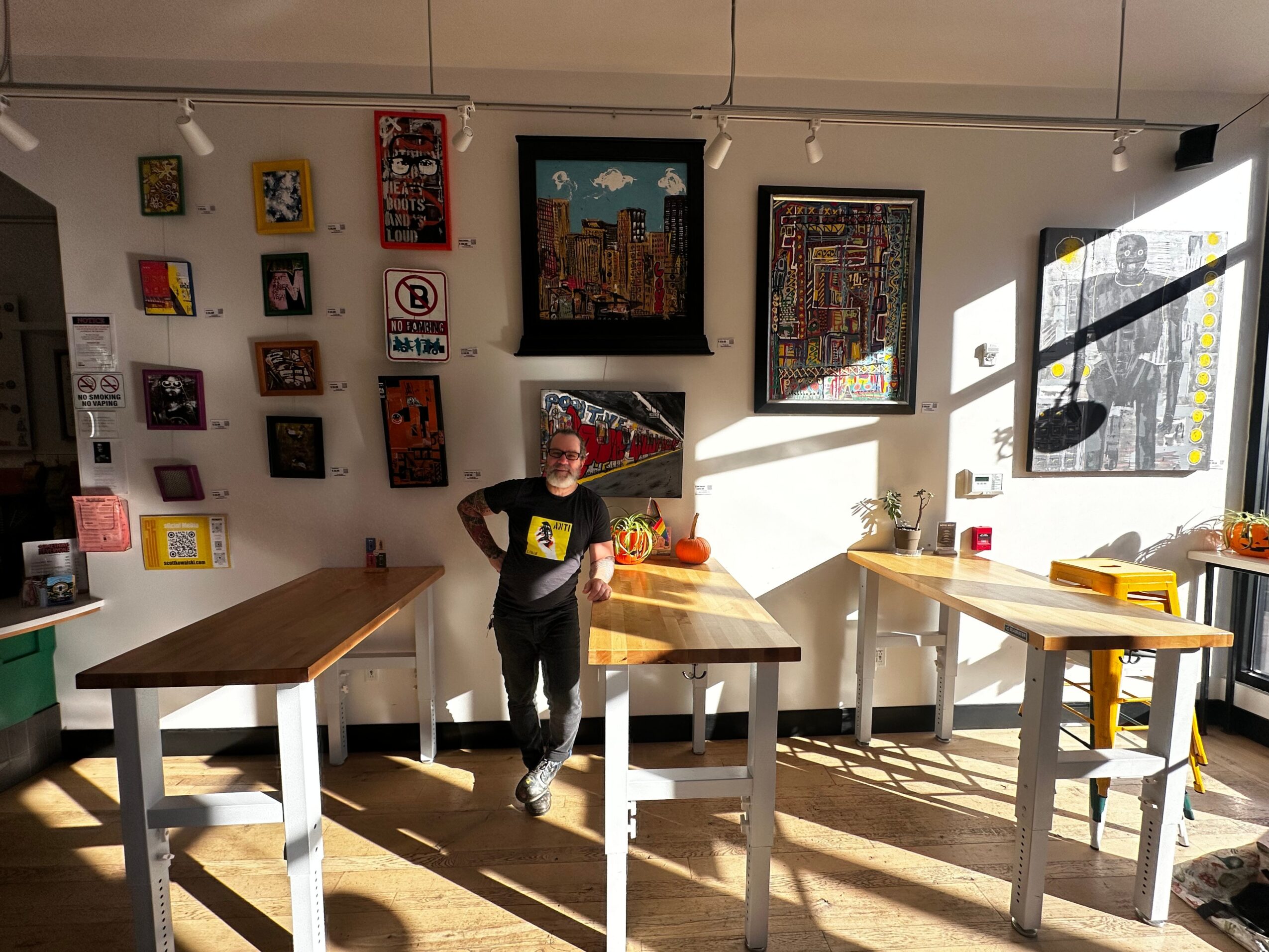
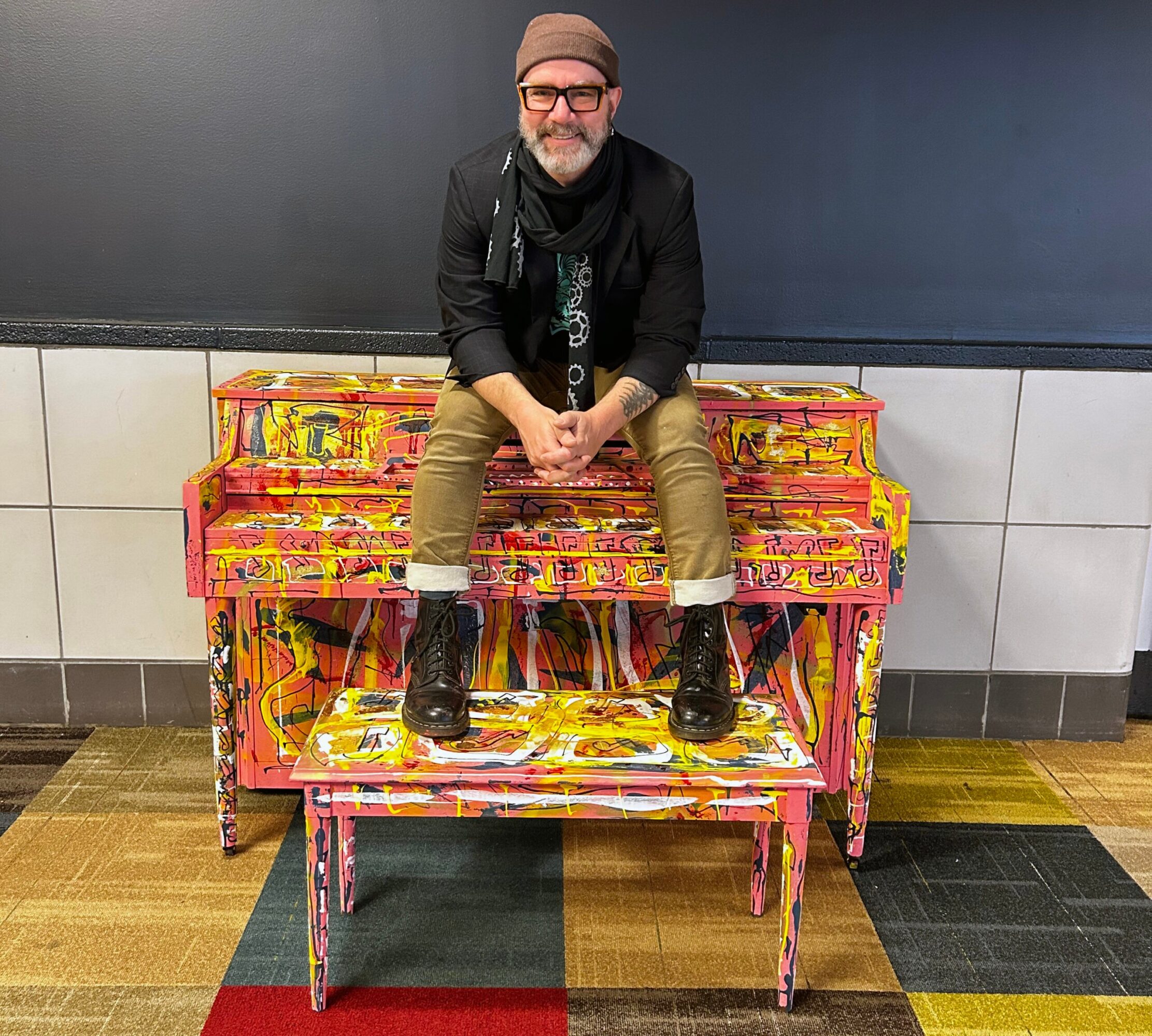
I consider myself an abstract expressionist, although I never expected to define myself by a particular style. I work primarily in acrylic on canvas, with vibrant color, loose forms, suggested rather than precise details, and sometimes elements of minimalism. I am especially known for my surreal, street-art-influenced cityscapes and my colorful interpretations of Pittsburgh’s bridges.
I also resist staying within a single subject or method. I work across several different series, including pure abstraction, cityscapes, stencil work, and paintings made with found, altered, or deconstructed signs. I rarely paint portraits or faces. The common thread is not necessarily the subject—it is the energy, color, looseness, and feeling behind the work.
I make most of my canvases myself. To me, that is not simply preparation; it is part of the process and part of the soul of the finished painting. I would almost always rather build a canvas than purchase one that is ready-made.
What sets me apart is that I do not think of myself only as a painter. I am an artist. There is a great deal of advice telling artists to find one recognizable subject or style and repeat it, but I find that limiting. I want creative challenges. Whether I am painting a bridge, deconstructing a sign, creating a mural, fabricating something, or working on a project I have never attempted before, I want the freedom to solve it in my own way. There will always be something recognizably Scott Kowalski in the result, but it comes through feeling and expression rather than a fixed formula.
I am particularly proud of the 30-by-90-foot mural I created for Humane Action Pennsylvania in Pittsburgh’s Strip District. It depicts a mama bear and her two cubs sitting in a meadow. Seeing people pass it, stop to take photographs, and become excited about it has meant a great deal to me. Even months later, I still receive unexpected messages from people telling me they saw my mural. Public art creates a connection with people I may never meet, and that is incredibly rewarding.
I am also proud that more than 600 of my artworks have found homes. The number itself is less important than what it represents. I believe original art should be accessible to ordinary people, so I try not to price my work beyond the reach of the average person. Knowing that hundreds of my pieces are now part of people’s homes and private collections feels like a meaningful accomplishment.
The next chapter is about scale and public impact. I want to create larger projects for cities and public-art programs, and I would love to make permanent work for an airport, major institution, or public space. I can also imagine filling the hallways of a large company with vibrant original art. Wherever the opportunities come from, I want the work to remain bold, accessible, and unmistakably mine.
Is there any advice you’d like to share with our readers who might just be starting out?
My first advice is to experiment before you allow the market to define you. Do not worry about whether you are supposed to be the next Monet, Picasso, Warhol, or anyone else. Just make the work. Paint what comes from your heart, do what you love, and accept that some people will respond to it and others will not.
At the same time, learn the business side early. Pricing your work is a reality. I use a consistent price-per-square-inch model, which gives an artist room to begin at an accessible level and increase prices as the work, audience, and career develop. You may believe completely in the value of your work, but the market does not know you yet. Your reputation and market value need time to grow with you.
Expect an extraordinary amount of rejection—from individuals, galleries, organizations, corporations, grant programs, and society in general. If your work is edgy or highly specific, expect even more. There is nothing wrong with choosing a niche, but understand that it may come with a narrower audience. Rejection is not proof that the work has no value; it is simply something every working artist must learn to survive.
Find a creative community. Inspiration, collaboration, and belonging matter enormously. Art All Night gave me all three, and finding that kind of community can help sustain you when the business or rejection becomes difficult.
Most importantly, ask yourself what you genuinely want instead of blindly following the path other people expect. At the end of your life, I think you will be happier saying, “I did it because I wanted to,” than saying, “I did it because everyone expected me to.”
Keep working, but give yourself permission to rest. I believe in creating something every day, though that does not always mean working in the same medium. Sometimes you may need to step away for a month or two—or even three—because you are burned out or simply need a break. That does not mean you have stopped being an artist; it is part of the process. Explore other creative outlets. They may inspire you to return to your original work with fresh energy, or they may lead you in an entirely new artistic direction.
Finally, do not be afraid of projects you have never attempted. No fear. You will always gain more knowledge by doing and failing than by never doing at all.
Pricing:
- Canvas paintings are priced per square inch.
- Mural work is priced per square foot
- Materials are normally included in the quoted price.
- If a project requires rented machinery, specialized equipment, or another unusual expense, that cost is listed separately and transparently on the invoice.
Contact Info:
- Website: https://www.scottkowalski.com/
- Instagram: https://www.instagram.com/scott.kowalski.art/
- Facebook: https://www.facebook.com/scott.kowalski.pittsburgh
- LinkedIn: https://www.linkedin.com/in/scott-kowalski/
- Youtube: https://www.youtube.com/@scottkowalskiart
- Other: https://www.tiktok.com/@scott_kowalski